HENGFENGYOU ELECTRIC --SMART ELECTRIC GLOBAL SERVICE PROVIDER



I. Project Overview and Technical Specifications for the 20000kVA-132/11kV Power Transformer
This solution represents a bespoke engineering package by Hengfengyou Electric for the "Cape of Good Hope Light" industrial distribution grid upgrade project in South Africa, featuring a customized 20000kVA/132kV three-phase dual-winding OLTC power transformer. Operating within a highly volatile grid environment and servicing heavy industrial loads, this transformer serves as the critical node linking the 132kV transmission grid to the local distribution network. Consequently, it must meet stringent local standards for high load capacity, ultra-stable voltage regulation, and environmental resilience. The scope of this solution spans the entire equipment lifecycle, from design validation and precision manufacturing to cross-border maritime logistics and on-site commissioning.
Table: Core Technical Parameters of the 20000kVA-132/11kV Power Transformer
Equipment Name: Three-Phase Dual-Winding On-Load Tap-Changing Power Transformer Equipment Model: SFZ11-20000/132 Rated Capacity: 20000 kVA Input Voltage (HV Side): 132 ± 8 × 1.25% kV Output Voltage (LV Side): 11.5 kV Voltage Regulation Mode: On-Load Tap Changing (OLTC with 17 steps, spanning 99 kV to 121 kV) Vector Group: YNd11 (HV side star-connected with neutral brought out; LV side delta-connected) Short-Circuit Impedance: 10.5% (High-impedance design to limit fault currents) Cooling Method: ONAN/ONAF (Oil Natural Air Natural / Oil Natural Air Forced dual-stage cooling) Anti-Corrosion / Protection Rating: High-spec heavy-duty anti-corrosion coating (UV-resistant, salt-spray resistant, and engineered for harsh industrial atmospheres)
II. Design and Engineering Phase
2.1 Advanced Electromagnetic and Short-Circuit Resistance Design To address the high fault rates and massive fault currents typical of the South African grid, the engineering team utilized advanced simulation platforms to fully optimize the transformer's core design. Serving as the primary safety barrier for the "Cape of Good Hope Light" project, the unit incorporates a high short-circuit impedance of 10.5% to effectively throttle low-voltage side fault currents. By running high-precision calculations on the electromagnetic and mechanical stresses generated during sudden short circuits, the internal force distribution across the windings was optimized. This significantly boosts both axial and radial mechanical strength, guaranteeing ample safety margins for dynamic and thermal stability under fault conditions.
2.2 Reinforced Structure and Thermal Management To withstand South Africa's intense summer heat, high solar radiation, and frequent thunderstorms, the following targeted designs were implemented: Cooling System Optimization: An ONAN/ONAF dual-stage cooling system was developed using dynamic thermal fluid flow simulations. Under low-load periods, the transformer runs on self-cooling (ONAN) to reduce substation energy consumption and acoustic noise. During midday peak temperatures or high-demand periods, the automated cooling fans kick in (ONAF). The temperature rise is tightly controlled well below IEC and national standards, ensuring the transformer can continuously deliver its full 20000 kVA capacity even in ambient temperatures exceeding 40°C. Lightning and Overvoltage Protection: Given the high frequency of lightning strikes in South Africa, the electrical clearance distances on both HV and LV sides were heavily optimized. Upgraded surge arrester interfaces were integrated into the design to significantly bolster the unit's resilience against atmospheric lightning and transient overvoltages.
2.3 Global Standards and Compliance Review The design successfully passed both Hengfengyou’s internal expert review and the technical grid-connection compliance audits required by the South African utility. The evaluation focused closely on load/no-load losses, noise levels, tap-changer response times, and the transformer's ability to withstand voltage surges and drops caused by frequent load shedding, ensuring full compliance with the grid-entry criteria of the project.
III. Manufacturing and Production Phase
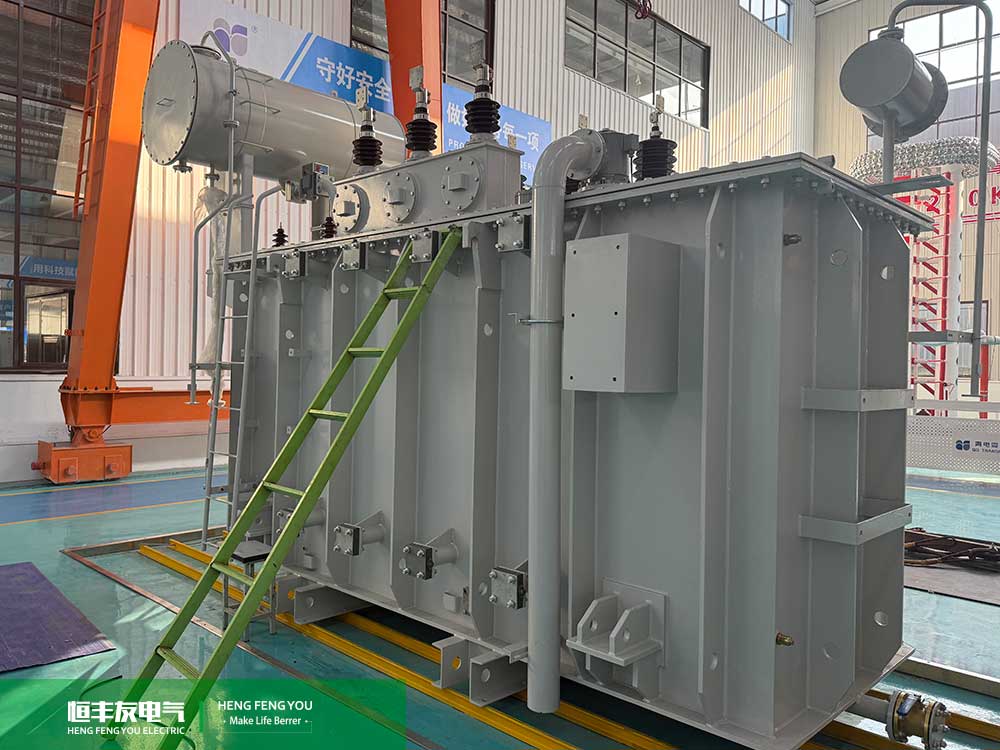
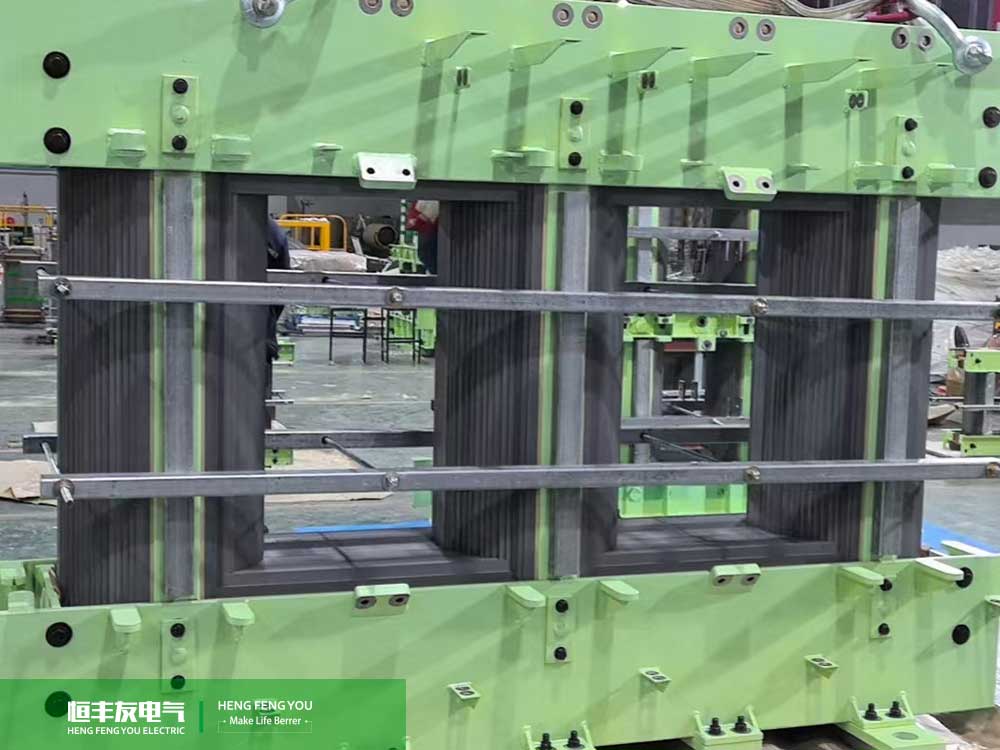
3.1 Core Component Manufacturing and Quality Inspection Core Assembly: The core is constructed using premium, high-permeability grain-oriented silicon steel sheets. Utilizing state-of-the-art step-lap stacking techniques, the assembly precision is tightly controlled to minimize no-load losses and electromagnetic noise. Winding Fabrication: The windings utilize high-strength continuously transposed conductors (CTC) along with an overall block-solidification process. This significantly enhances the mechanical rigidity against external short-circuit impacts while maintaining optimal electrical conductivity. Material Re-testing: All critical raw materials—including copper conductors, insulation paper, and transformer oil—undergo 100% electrical and physicochemical testing upon factory arrival to guarantee zero defects.
3.2 Intelligent OLTC Module Integration The transformer features an integrated, intelligent automatic control cabinet paired with a 132 ± 8 × 1.25% kV on-load tap changer. This configuration provides 17 distinct tap positions, covering a regulation range from 99 kV to 121 kV. The system automatically and seamlessly shifts taps based on real-time grid voltage fluctuations. This dynamic regulation requires no interruption to the power supply, ensuring a stable 10.5 kV output on the low-voltage side to protect sensitive downstream industrial equipment.
3.3 Premium Surface Anti-Corrosion Treatment To cope with the dusty, coastal salt-spray, and polluted industrial environments of South Africa, the transformer tank and radiators undergo a high-specification heavy-duty coating process. After thorough abrasive blasting and rust removal, the surfaces are coated with a specialized multi-layer system that offers superior UV resistance, salt-spray endurance, and industrial chemical protection, ensuring decades of reliable outdoor service.
IV. Factory Acceptance Testing (FAT) Phase
Prior to dispatch, the transformer undergoes rigorous type and routine testing in Hengfengyou’s high-voltage test bay. Third-party certified witness reports are provided for all major assessments:
4.1 Laboratory Stress Testing The transformer is subjected to simulated short-circuit and continuous cyclic load-fluctuation tests to verify its fatigue strength against a fragile grid architecture.
4.2 Routine and Type Tests Lightning Impulse Test: Full-wave and chopped-wave lightning impulse tests are conducted on the high-voltage windings to validate the integrity of the insulation system against severe lightning storms. Partial Discharge (PD) Measurement: PD levels are strictly monitored and kept well below standard thresholds under the required test voltages, ensuring the insulation system is free of latent defects. Temperature Rise Test: Full-load thermal runs are conducted to simulate South Africa's extreme ambient temperatures, validating the real-world heat dissipation efficiency of the ONAN/ONAF systems. OLTC Operational Test: Continuous tap-changing sequence tests are performed under voltage to guarantee the smoothness, timing, and precision of the intelligent controller and switching mechanism.
V. Packaging, Logistics, and Global Delivery
5.1 Cross-Border Logistics Standards To endure the mechanical rigors of ocean freight and long-haul inland road transport across South Africa, the transformer is shipped oil-filled with specialized heavy-duty internal bracing. The transit setup includes pre-installed 3-axis impact recorders and GPS tracking units, allowing the logistics team to monitor real-time location, vibration levels, and mechanical shock data throughout the journey.
5.2 Vertically Integrated Project Delivery Leveraging Hengfengyou Electric's multi-division vertically integrated manufacturing capabilities, the company provides a one-stop engineering solution that bridges everything from the high-voltage grid connection down to the low-voltage distribution units. This highly coordinated approach shortens the construction timeline of the "Cape of Good Hope Light" project and eliminates technical interface risks during on-site installation.
VI. Site Acceptance Testing (SAT) and Commissioning
6.1 On-Site Handover and Installation Hengfengyou’s field service team, working alongside local partners and South African engineers, manages the unboxing inspection, reviews the impact recorder data logs, and supervises the final positioning of the unit. On-Site Oil Filling: The transformer is vacuumed to strict specified levels before being filled with certified insulation oil. A rigorous oil-resting and degassing process is executed to ensure all microscopic air bubbles are completely evacuated.
6.2 On-Site Commissioning Tests Site acceptance testing is conducted in strict accordance with international standards: Winding Deformation Test: Frequency Response Analysis (FRA) is performed and compared meticulously against the original factory baseline fingerprints. This confirms that no internal mechanical shifting or damage occurred during ocean and land transit. System Integration Testing: End-to-end signal validation is carried out to ensure the transformer's OLTC system, intelligent control cabinet, and the substation automation system (SCADA) communicate flawlessly.
6.3 Energization and Commercial Operation The transformer is successfully integrated into the grid following five consecutive no-load switching impulses and a subsequent progressive load-bearing trial. This confirms smooth voltage and current transformation under actual South African grid conditions, with all operational metrics meeting design criteria.
VII. Total Quality Control Management
A comprehensive quality assurance framework governs the entire lifecycle of the transformer, structured around six critical hold points: Design Review, Raw Material Inspection, In-Process Semi-Finished Testing, FAT, Logistics Monitoring, and SAT. Each unit is delivered with an exhaustive bilingual (Chinese/English) technical documentation package, including factory test certificates, original quality certificates, and a comprehensive lifecycle maintenance manual to ensure absolute traceability.
VIII. Conclusion
Power transformers represent a foundational capital asset for any industrial grid. The SFZ11-20000/132 power transformer solution delivered by Hengfengyou Electric (hfy@hengfengyou.com) for South Africa's "Cape of Good Hope Light" project goes far beyond a standard equipment supply. It is a highly engineered, bespoke "heart for the power distribution network," tailored specifically to solve South Africa's unique energy challenges and operational pain points. By combining field-proven OLTC technology, robust short-circuit resistance, and an experienced overseas engineering service network, Hengfengyou turns a volatile grid into a rock-solid power supply—safeguarding operational continuity and injecting reliable, powerful momentum into local industrial growth and economic development.
WhatsApp:
+86 15853252696(Jack)
+86 135 8926 2999(MARTIN)
Tel:+86-532-87936206
Fax:+86-532-87936207
Email: hfy@hengfengyou.com
Address: Address: No.638,Zhongcheng Road, Chengyang District, Qingdao City,China
Leave a message now - get the latest industry insights, star products, and success stories of hengfengyou electric