HENGFENGYOU ELECTRIC --SMART ELECTRIC GLOBAL SERVICE PROVIDER



Writer: Hengfeng you electric Time:2026-07-31 views:times
A three-phase oil-immersed transformer is a power transformer where the core and windings are fully submerged in insulating oil, utilizing the oil to achieve insulation, heat dissipation, and cooling simultaneously. Its core structure comprises the iron core, windings, oil tank, insulating oil, bushings, tap changer, and protective safety devices.
The insulating oil serves as both an insulating and cooling medium. During operation, heat generated by the windings and core is transferred to the tank walls via oil convection, and subsequently dissipated into the ambient air through the tank surfaces. For high-capacity units, heat dissipation can be further enhanced by installing radiators or cooling fans for forced air cooling.
Based on cooling methods, three-phase oil-immersed transformers are classified into Oil Natural Air Natural (ONAN), Oil Natural Air Forced (ONAF), and Oil Forced Water Forced (OFWF) types. Among these, the ONAN type is most widely deployed in power distribution due to its simple structure and high operational reliability.
The operating principle of a three-phase oil-immersed transformer is grounded in Faraday's Law of Electromagnetic Induction. When a three-phase AC power supply is energized at the primary windings, an alternating magnetic flux is generated in the iron core. This flux links the secondary windings, inducing an electromotive force (EMF) across them. By precisely engineering the turns ratio between the primary and secondary windings, stepping up or stepping down the voltage is achieved.
The transformer core is built with high-permeability, cold-rolled grain-oriented (CRGO) silicon steel laminations to form a fully closed magnetic circuit. In a three-phase system, there are three core limbs corresponding to Phases A, B, and C, with each phase winding wrapped around its respective limb. Three-phase windings can be connected in Star (Y) or Delta (Δ) configurations to meet diverse grid interconnection requirements.
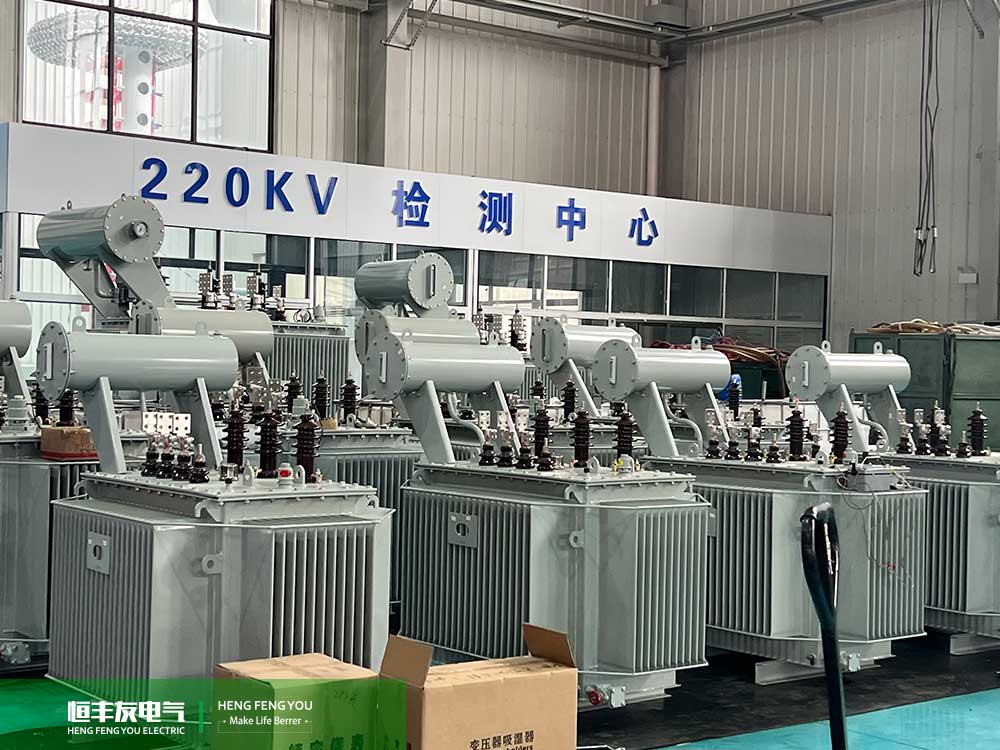
Hunter, Technical Manager at Hengfengyou Electric (hunter@hengfengyou.com), points out that three-phase oil-immersed transformers possess irreplaceable comprehensive advantages under outdoor and heavy-load operating conditions:
Superior Heat Dissipation & Robust Overload Capacity: Insulating oil exhibits excellent thermal conductivity, efficiently transferring internal heat to the tank exterior. Compared to dry-type transformers, oil-immersed transformers achieve higher thermal dissipation efficiency and stronger short-term overload capabilities, making them particularly suitable for high-fluctuation load profiles.
Reliable Insulation & Extended Service Life: Transformer oil features high dielectric strength, effectively safeguarding insulation integrity between windings. Under normal operating conditions, the design life of a three-phase oil-immersed transformer reaches up to 30+ years with minimal maintenance demands.
High Cost-Performance Ratio & Low Lifecycle Cost: At equivalent capacity ratings, the manufacturing cost of an oil-immersed transformer is significantly lower than that of a dry-type unit. For outdoor installations where fire safety codes are not extraordinarily restrictive, it represents the most economical and high-efficiency choice.
The table below summarizes key structural and operational differences between three-phase oil-immersed transformers and three-phase dry-type transformers across seven critical parameters:
| Comparison Dimension | Three-Phase Oil-Immersed Transformer | Three-Phase Dry-Type Transformer |
| Insulating Medium | Transformer Insulating Oil | Epoxy Resin or Air |
| Cooling Method | ONAN / ONAF / OFWF | AN (Air Natural) / AF (Air Forced) |
| Thermal Dissipation Performance | High thermal efficiency; robust short-term overload tolerance | Moderate thermal dissipation; limited overload capacity |
| Installation Site | Primarily outdoor; indoor permitted (requires oil containment pit) | Primarily indoor; excellent flame-retardant and self-extinguishing safety |
| Maintenance Requirements | Periodic oil sampling/testing and seal condition inspection | Low maintenance; routine dust removal |
| Overall Cost | Low initial CAPEX & lifetime OPEX | Higher equipment procurement cost |
| Application Scenarios | Distribution lines, industrial & mining enterprises, renewable plants | Data centers, subways, high-rise commercial buildings |
Urban & Rural Distribution Grids: Serving as critical grid assets performing 10 kV / 0.4 kV or 33 kV / 0.4 kV voltage stepping, acting as workhorses in rural power upgrades and urban grid retrofits.
Industrial & Mining Sectors: Delivering high-reliability power distribution for manufacturing plants, mining facilities, chemical complexes, and metallurgical plants.
Renewable Energy Integration: Widely applied as step-up transformers (GSU) and auxiliary transformers in utility-scale solar PV power plants and onshore wind farms.
Infrastructure & Temporary Power Supply: Providing power infrastructure support for railways, airports, sea ports, as well as mobile pad-mounted substations and temporary construction sites.
When specifying a three-phase oil-immersed transformer, particular attention should be given to the following technical parameters:
Rated Capacity (kVA): Determine total capacity based on real-time load demand, power factor, and future expansion margin.
Voltage Rating & Tap Range: Ensure primary and secondary rated voltages match local utility specifications, and select an appropriate Off-Circuit Tap Changer (DETC) or On-Load Tap Changer (OLTC).
Vector Group: Standard connections include Yyn0, Dyn11, etc. The Dyn11 vector group offers superior performance in suppressing harmonics and handling single-phase unbalanced loads.
Impedance Voltage & Energy Efficiency Class: Align with local mandatory energy efficiency codes (such as GB 20052 or IEC Eco-design standards) to minimize long-term operational losses.
As time-tested yet continuously innovating core apparatus in power systems, three-phase oil-immersed transformers maintain an indispensable position in power distribution thanks to their outstanding cooling performance, heavy overload capacity, high reliability, and exceptional cost efficiency. Whether for grid retrofits, renewable integration, or industrial distribution engineering, selecting an appropriately specified oil-immersed transformer is a strategic choice balancing technical dependability with economic performance.
Hengfengyou Electric specializes in manufacturing 11 kV and 33 kV distribution transformers, alongside medium/low-voltage switchgears. Since 2018, our equipment has been successfully deployed in Middle Eastern markets, including Iraq, Kuwait, the UAE, Oman, and Qatar. Backed by 30 years of power transformer and switchgear manufacturing expertise and 20 years of OEM/ODM service experience for European and American markets, Hengfengyou Electric provides optimal power equipment solutions tailored to your projects.
Email: hunter@hengfengyou.com
WhatsApp / Mobile: +86 182 2442 9139
National Standard GB/T 6451: Specification and Technical Requirements for Oil-Immersed Power Transformers
National Standard GB 20052: Minimum Allowable Values of Energy Efficiency and Energy Efficiency Grades for Three-Phase Distribution Transformers
International Electrotechnical Commission IEC 60076 Series: Power Transformers Standards
WhatsApp:
+86 13969788801
+86 15853252696
Tel:+86-0532-68688801
Fax:+86-0532-87038801
Email: hfy@hengfengyou.com
Address: No.638,Zhongcheng Road, Chengyang District, Qingdao City,China
Leave a message now - get the latest industry insights, star products, and success stories of hengfengyou electric