HENGFENGYOU ELECTRIC --SMART ELECTRIC GLOBAL SERVICE PROVIDER



Writer: Hengfeng you electric Time:2026-07-17 views:times
The transformer test includes type test, routine test, and special test, among which the temperature rise test is one of the most critical type tests.
This test is mainly conducted to check the structural performance of the transformer. Specifically, it verifies whether the transformer can be cooled quickly—that is, whether the heat generated by the total loss can be dissipated efficiently during operation. Additionally, it ensures the unit meets the top oil temperature rise limit and the winding temperature rise limited values specified in the IEC 60076-2 standard.
It is also necessary to check whether other components experience localized overheating, such as the: Iron core, Oil tank, Structural metal parts
Since December 14, 2014, the temperature rise test of oil-immersed transformers in China has implemented the Chinese National Standard GB/T 1094.2-2013 (IEC 60076-2:2011).
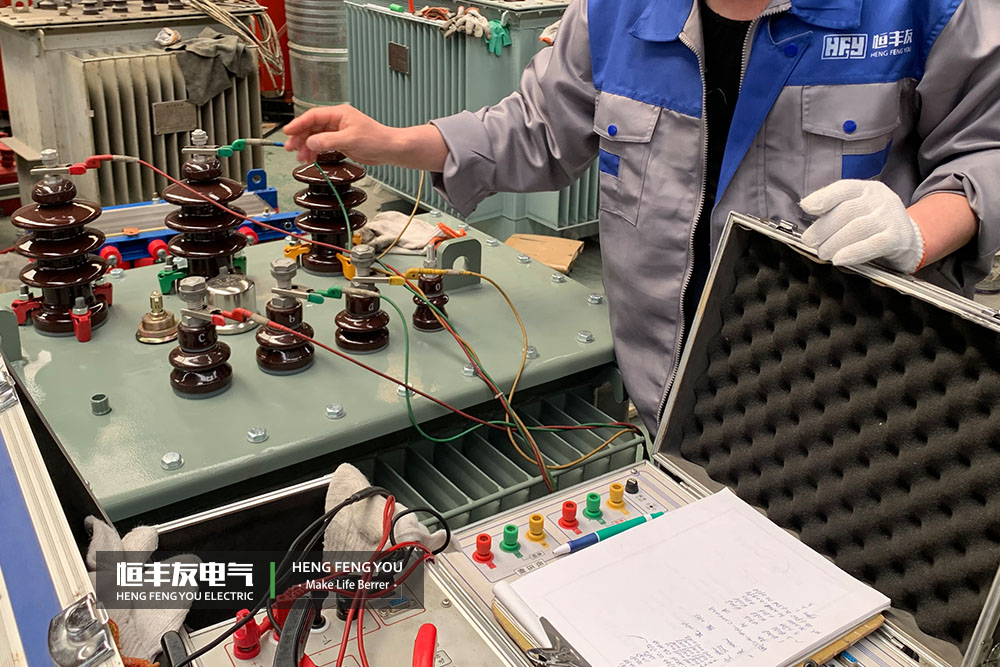
In the process of transformer testing, the temperature rise test is often the most time-consuming procedure with the largest workload. Currently, the primary methods used to test the temperature rise of a transformer include:
Direct Load Method
Mutual Load Method
Circulating Current Method
Zero-Sequence Current Method
Short-Circuit Method
Among these, the short-circuit method requires the lowest test voltage and the smallest power capacity. Moreover, for oil-immersed transformers, international and national standards stipulate the short-circuit method as the standard method for temperature rise testing.
Below, we share how to carry out the temperature rise experiment for an oil-immersed transformer using this method.
The execution of the short-circuit temperature rise test is divided into two core phases:
Connection: Short-circuit the outgoing terminals of the low-voltage (LV) side of the tested transformer.
Power Supply: Apply the calculated total loss to the high-voltage (HV) side of the transformer to begin the test.
Monitoring & Recording: During the test, regularly monitor and record critical temperature values every half hour, including:
-Ambient temperature of the surrounding environment
-Top oil layer temperature
-Inlet and outlet temperatures of the radiator
Duration & Stability: The typical test time is 3 hours. When the temperature rise variation of the monitored parts is less than 1°C per hour, the temperature rise is considered stable. We average the values of the last 1 hour of testing to use as the final result.
Winding Current: Adjust the input current of the winding until it reaches the rated current.
Stabilization: After continuous monitoring for 1 hour, record the ambient temperature, top oil temperature, and the inlet/outlet radiator temperatures.
Resistance Measurement: Cut off the power supply immediately, minimize the current, and measure the thermal resistance value to calculate the temperature rise of the winding group.
WhatsApp:
+86 13969788801
+86 15853252696
Tel:+86-0532-68688801
Fax:+86-0532-87038801
Email: hfy@hengfengyou.com
Address: No.638,Zhongcheng Road, Chengyang District, Qingdao City,China
Leave a message now - get the latest industry insights, star products, and success stories of hengfengyou electric