HENGFENGYOU ELECTRIC --SMART ELECTRIC GLOBAL SERVICE PROVIDER



Writer: Hengfeng you electric Time:2026-04-29 views:times
Kenya will fully implement IE2 mandatory energy efficiency in 2026, with government projects prioritizing the IE3 standard. Grid losses across the KPLC network have long exceeded 13%, with distribution transformer no-load and load losses accounting for over 42%, making them the core target for loss reduction. This report is interpreted for you by Simon (simon@hengfengyou.com), Kenya Market Head at Hengfengyou Electric, regarding the latest energy efficiency compliance requirements in Kenya.
I. Market Background of No-Load and Load Losses for Distribution Transformers in Kenya Kenya will fully enforce IE2 mandatory energy efficiency in 2026, with IE3 preferred for government projects. KPLC's total network loss has long been above 13%, with distribution transformer losses accounting for over 42%, making them the primary target for governance.
Aging equipment mainly uses ordinary silicon steel sheets, with no-load losses generally exceeding standards by 25%–40%.
Starting from 2026, all products entering the grid must provide IEC 60076 FAT (Factory Acceptance Test) loss reports.
Dual regulation by KEBS and EPRA; products with excessive losses will be intercepted at customs and rejected.
Massive integration of PV and microgrids requires dual indicators of low loss and fluctuation resistance.
II. Definitions of No-Load/Load Loss and Kenyan Standard Requirements
Basic Definitions
No-load Loss: Core loss; occurs during 24-hour continuous electrification; determines annual power consumption.
Load Loss: Winding copper loss + stray loss; varies with load; determines overload capacity and temperature rise.
2026 Kenya Mandatory Standards for Distribution Transformers
| Capacity (kVA) | Max No-load Loss (W) IE2 | Max No-load Loss (W) IE3 | Max Load Loss (W) IE2 | Max Load Loss (W) IE3 |
| 100 | 280 | 235 | 1800 | 1530 |
| 250 | 520 | 440 | 3450 | 2930 |
| 400 | 720 | 610 | 4750 | 4040 |
| 630 | 950 | 805 | 6200 | 5270 |
| 1000 | 1320 | 1120 | 8600 | 7310 |
Correspondence: Kenya Energy Efficiency Standards ≡ China S-Grade Standards Kenya implements IEC 60076-11 energy efficiency grading, which directly corresponds to China's S-series oil-immersed distribution transformers. Selection for export can be benchmarked as follows:
Kenya IE2 (Mandatory Entry) ≡ China S11 Energy Efficiency Standard
Kenya IE3 (Government Project Priority) ≡ China S13 Energy Efficiency Standard
Kenya High-Efficiency Type ≡ China S15 Amorphous Alloy Standard (Lower losses for ultra-high requirements)
Key Compliance Clauses
Testing must be completed in ISO 17025 laboratories; reports are valid for 1 year.
Measured values allow a +15% IEC tolerance; exceeding this results in direct failure.
Nameplates must state: No-load loss, Load loss, Energy efficiency grade, and KEBS certification number.
KPLC tender technical specifications directly link to guaranteed loss values as the basis for acceptance.
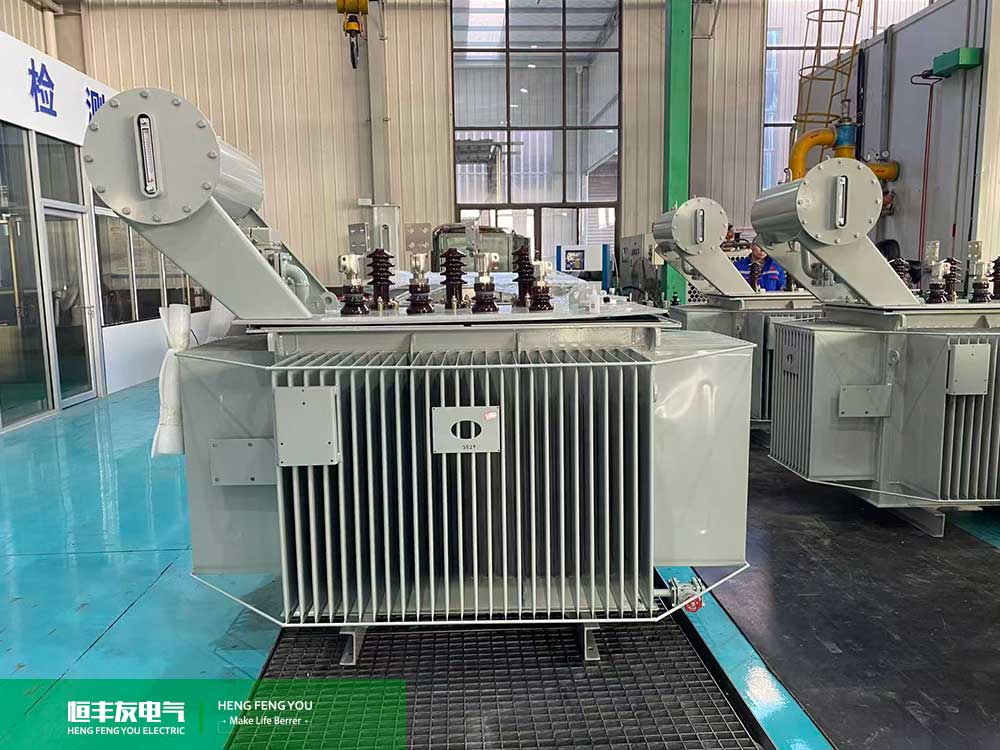
III. Causes of High Losses and On-site Pain Points in Kenya
Equipment Aging: Over 42% of transformers on the grid have operated for over 25 years, leading to core degradation and rising losses.
Outdated Materials: Extensive use of ordinary silicon steel sheets instead of low-loss materials.
Harsh Environment: High temperature and humidity accelerate insulation aging, further increasing losses.
Unreasonable Operation: Long periods of light/no-load operation amplify the proportion of no-load losses.
Lax Enforcement: Early imported products lacked strict loss control.
IV. Hengfengyou Electric Loss Optimization Technical Solutions
No-Load Loss Optimization (Reducing Iron Loss)
Use of high-permeability oriented silicon steel or amorphous alloys, reducing no-load loss by 30%–60% compared to conventional types.
Step-lap + full-oblique joint core technology to reduce excitation loss.
Vacuum drying + epoxy encapsulation to reduce stray losses.
Capacity attenuation ≤5% in high-temperature environments, adapted to Kenya's climate.
Load Loss Optimization (Reducing Copper Loss)
High-conductivity oxygen-free copper windings, reducing DC resistance by 4%–6%.
Transposed conductors + low-impedance design to reduce eddy current and stray losses.
Forced oil circulation cooling, temperature rise controlled ≤55K, ensuring long-term stable low loss.
Exclusive Design for Kenya
Wide voltage regulation ±2×2.5% to adapt to grid voltage fluctuations.
IP54 protection against moisture and dust, extending the low-loss cycle.
Support for SCADA remote loss monitoring to meet smart grid requirements.
Products strictly designed according to S11/S13, perfectly matching Kenya's IE2/IE3 entry requirements.
Market Competitive Landscape
| Dimension | Local / Conventional Brands | Global Tier-1 Brands (ABB/Siemens) | Hengfengyou Electric Advantages |
| Efficiency Level | Mostly IE1 or barely IE2 | Meet IE3, but at premium pricing | IE3+ standards: Benchmarked to China S13/S15; 15%-25% lower loss than IE2 |
| Loss Guarantee | High risk of rejection; only meet basic IEC tolerance | Precise control but slow non-standard customization | KPLC Deep Customization: Strictly locked to KPLC tender values for 100% KEBS pass rate |
| Certification | Long cycles; lack international test reports | Full certification but complex entry processes | Green Channel: Complete PVoC/CoC expertise and ISO 17025 lab reports provided |
| Delivery Cycle | 16-24 weeks due to supply chain constraints | 24-40 weeks due to global production queues | Fast Delivery: Optimized supply chain allows delivery in 10-14 weeks |
| Adaptability | Standard designs; vulnerable to East African dust | Standardized products; high on-site modification costs | Reinforced Design: Enhanced cooling and sealing; 30% better extreme load tolerance |
V. Test Certification and KPLC Acceptance Requirements
FAT Type Test: Full items including no-load loss, load loss, impedance voltage, and temperature rise.
KEBS PVoC Certification: Loss data is a mandatory verification item; the certificate must be held by a local representative.
Site Acceptance: Random testing upon arrival; measured value ≤ Guaranteed Value × 1.15 (IEC tolerance).
Energy Efficiency Label: Must display model, capacity, no-load/load loss values, energy efficiency grade, and QR code.
VI. Conclusion By 2026, the Kenyan distribution market has entered an era of strict energy efficiency regulation. No-load and load losses are the entry threshold, evaluation weight, and acceptance red line. Kenya IE2 = China S11, IE3 = China S13; domestic manufacturers can directly match exports according to the S-series. IE3 low-loss products can help power companies save 15%–25% of electricity annually, significantly reducing grid losses and operating costs. Hengfengyou Electric's full range of products meets KEBS/IEC 60076/IE3 requirements, with loss values 10%–15% better than the standard. We provide one-stop services for testing, certification, and delivery to help win bids for Kenyan grid and industrial/commercial projects. If you are participating in KPLC or Kenyan industrial park projects, please contact Simon (simon@hengfengyou.com), our Kenya Market Head, for the latest loss calculation sheets and quotation plans.
Data Sources
Kenya KEBS KS IEC 60076-11:2026 Energy Efficiency Standard
Kenya Power KPLC 2026 Distribution Transformer Tender Technical Specifications
IEC 60076-11 Power Transformers Loss Testing Standard
EPRA Energy Management Regulations (2026 Amendment)
China GB 20052-2024 "Minimum Allowable Values of Energy Efficiency and Energy Efficiency Grades for Power Transformers"
CEIC East Africa Power Equipment Database
WhatsApp:
+86 13969788801
+86 15853252696
Tel:+86-0532-68688801
Fax:+86-0532-87038801
Email: hfy@hengfengyou.com
Address: No.638,Zhongcheng Road, Chengyang District, Qingdao City,China
Leave a message now - get the latest industry insights, star products, and success stories of hengfengyou electric