Key Selection Points for KYN28A-12 High-Voltage Switchgear: How to Determine Rated Current, Dynamic & Thermal Stability, and Protection Configuration?
Writer: Hengfeng you electric Time:2026-08-23 views:times
Ⅰ. Product Classification of KYN28A-12 Switchgear
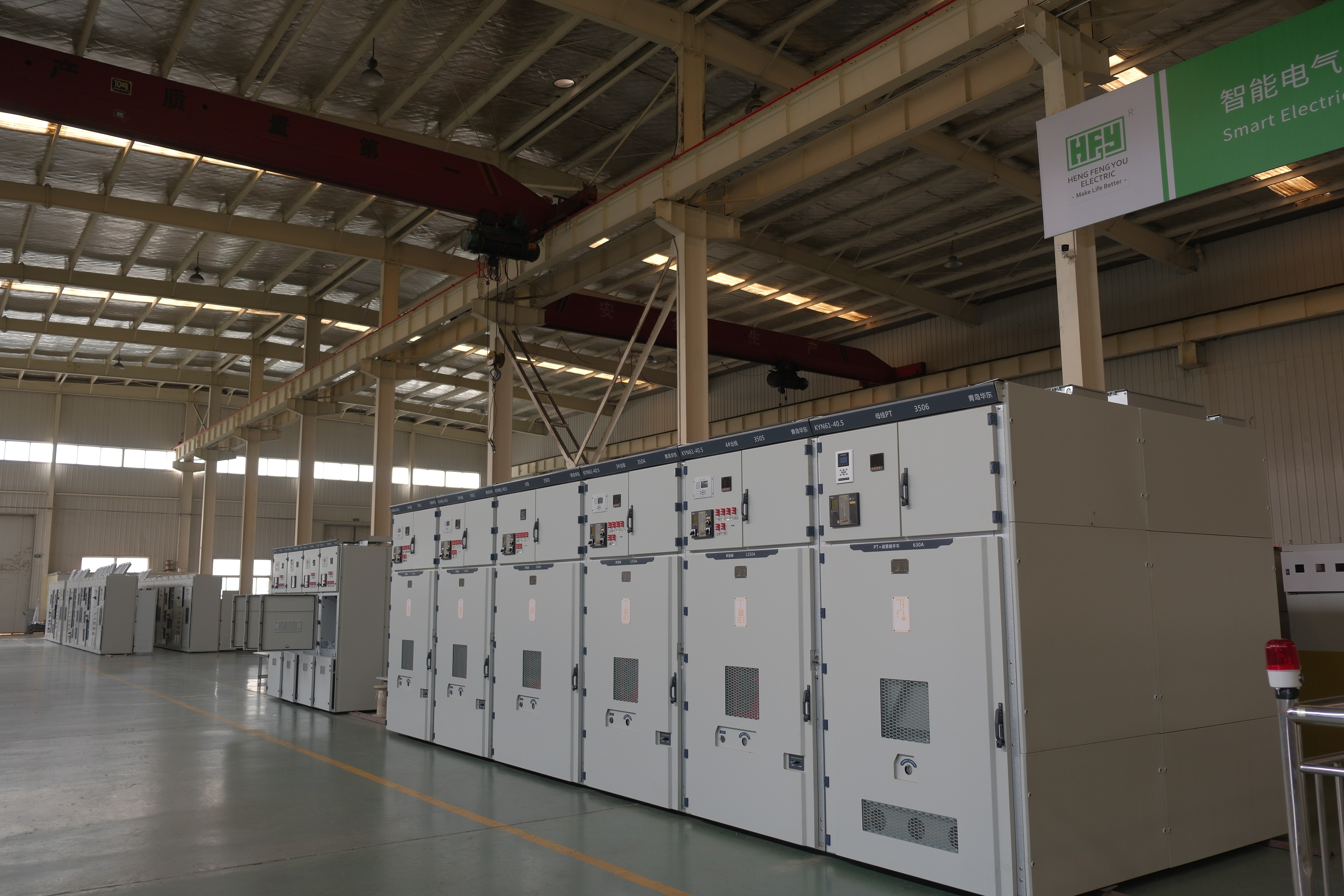
The KYN28A-12 is a 10kV indoor, middle-mounted high-voltage switchgear widely used in 10kV distribution systems. It is primarily categorized into incoming cabinets, outgoing cabinets, PT (potential transformer) cabinets, metering cabinets, bus-coupler cabinets, and lightning arrester cabinets.
Core components include vacuum circuit breakers, current transformers (CTs), voltage transformers (PTs), earthing switches, main busbars, branch busbars, secondary protection and control devices, metal enclosures, and pressure relief channels. The vacuum interrupter handles fault current interruption, while the metal enclosure provides isolation and protection.
Compared to older XGN fixed-type switchgear, the KYN28A-12 features a withdrawable circuit breaker truck for easy maintenance and replacement, as well as pressure relief channels for arc containment. However, the reliability of the equipment heavily depends on the quality of the selected components. It is predominantly used in industrial and commercial facilities, substations, PV step-up stations, and large building distribution rooms.
Ⅱ. How to Accurately Match Rated Current and Busbar Parameters?
The rated current specification involves two distinct indicators: the rated current of the circuit breaker and the rated current of the main busbar. These must not be confused and should be calculated based on transformer capacity and circuit load.
1. Standard Selection Reference:
-
800A: Suitable for transformer circuits ≤800kVA; outgoing circuits for small processing plants.
-
1250A: Incoming lines for 1000–1600kVA transformers; the most common specification for industrial parks.
-
1600A–2000A: Incoming lines for main transformers ≥2000kVA and bus-coupler circuits.
-
2500–3150A: Scenarios involving parallel operation of multiple transformers or high-current busbars.
Selection Principle: The rated current of the main busbar must be ≥ the maximum operating current; the current rating of the incoming cabinet must not be lower than that of the main busbar.
2. Temperature Rise and Heat Dissipation Constraints:
In facilities with multiple high-power VFDs or significant harmonic loads, the busbar current rating should be upgraded by one level to prevent overheating. In enclosed prefabricated cabins with poor ventilation, heat-dissipating reinforced enclosures are mandatory.
Case Study 1: Overheating Failure Due to Undersized Busbars in an Industrial Park
In a food industrial park, two 1600kVA transformers were installed. To cut costs, KYN28A-12 incoming cabinets with 1250A main busbars were procured. When both transformers ran at full load simultaneously, combined with harmonics from extensive VFD equipment, the actual busbar current approached 1300A. This caused severe overheating, insulation aging, and persistent over-temperature alerts during infrared thermography inspections.
The subsequent shutdown for reconstruction—replacing the entire lineup with 1600A busbar cabinets—resulted in a production loss totaling 92,000 CNY.
Lesson Learned: In environments with harmonics or sealed prefabricated cabins, the busbar current rating must include a margin of over 20%, rather than relying solely on theoretical operating current calculations.
Ⅲ. Short-Time Withstand Current (Dynamic & Thermal Stability) Selection: Standards for Short-Circuit Scenarios
The short-time withstand current (thermal stability) and peak withstand current (dynamic stability) define the switchgear’s ability to withstand short-circuit impacts. Mainstream ratings include 20kA/2s, 25kA/2s, 31.5kA/3s, and 40kA/3s, which must correspond to the short-circuit impedance of the upstream transformer.
-
25kA/2s: Small processing plants with transformer capacity ≤1000kVA and low short-circuit currents.
-
31.5kA/3s: The industry-standard configuration for most industrial plants and commercial buildings.
-
40kA/3s: Large-capacity main transformers, chemical parks, PV step-up stations, and parallel transformer operations.
Note: The short-time withstand ratings of the circuit breaker, CTs, busbars, and enclosure must be uniform. Mismatches—such as a 31.5kA enclosure paired with a 25kA circuit breaker—must be avoided.
Case Study 2: Switchgear Destroyed by Short-Circuit Due to Insufficient Dynamic & Thermal Stability
At a building materials production plant with a 2000kVA main transformer, the 10kV incoming KYN28A-12 switchgear was specified at a 25kA rating. A phase-to-phase short-circuit occurred in the high-voltage cable, generating a fault current exceeding the switchgear’s tolerance. This resulted in busbar deformation, insulation breakdown, and an internal arc flash. High-temperature gases vented through the pressure relief flaps, destroying the high-voltage room. The plant suffered a total blackout for 8 days, incurring 420,000 CNY in direct losses.
Rectification Plan: All switchgear was upgraded to a 31.5kA/3s rating, and fault warning monitoring was added to the cables.
Ⅳ. Core Points for Relay Protection and Secondary System Selection
Protection Device Configuration:
-
Incoming/Bus-coupler Cabinets: Overcurrent, instantaneous trip, zero-sequence protection, and overload alarm.
-
Transformer Outgoing Cabinets: Instantaneous trip, overcurrent, zero-sequence, and high-temperature trip.
-
*PT Cabinets: Overvoltage, undervoltage, and PT disconnection alarms.
Secondary Circuit Requirements:
For critical industrial projects, independent control and protection devices should be selected over simplified integrated protection. The system must support remote signaling (teleindication), remote measurement (telemetering), and remote control (telecommand), with compatibility for IEC 61850 or IEC 104 protocols for backend communication.
Mechanical and Electrical Interlocking:
Interlocks must be in place for the truck’s "Service" and "Test" positions, between the earthing switch and circuit breaker, and for the cabinet door to prevent misoperation.
Ⅴ. Essential Auxiliary Selection Parameters (Beyond Current, Stability, and Protection)
-
Enclosure Protection: IP2X for indoor substations; IP3X recommended for prefabricated cabins; moisture-resistant reinforced enclosures for damp basements.
-
Circuit Breaker Selection: Spring mechanisms for small-to-medium projects; permanent magnet vacuum circuit breakers for circuits requiring frequent operation.
-
Pressure Relief Channels: Top-mounted pressure relief channels are mandatory to vent arc pressure during internal faults.
-
Environmental Adaptation: For high-altitude regions, CTs and insulators require altitude correction. In coastal salt-spray environments, the enclosure should feature anti-corrosion coating.
Ⅵ. Summary of Common KYN28A-12 Selection Pitfalls
-
Specifying a circuit breaker in the incoming cabinet with a lower current rating than the main busbar, leading to long-term overheating.
-
Mismatched short-time withstand ratings among the enclosure, circuit breaker, and CTs, creating weak links that cause short-circuit damage.
-
Failing to increase current margins in facilities with high harmonics, resulting in excessive temperature rise and accelerated insulation aging.
-
Neglecting insulation and anti-corrosion corrections for high-altitude or coastal salt-spray environments, leading to surface discharge.
-
Opting for cheap, simplified protection devices that fail to trip during faults, thereby expanding the scope of the accident.
Ⅶ. Conclusion
Selecting KYN28A-12 high-voltage switchgear should never be based solely on price comparison. Rated current and busbar parameters determine the equipment's long-term current-carrying capacity; short-time dynamic and thermal stability ensure safety during short-circuit faults; and relay protection enables rapid fault isolation. None of these three elements can be compromised.
-
For standard SME factories, a 1250A, 31.5kA/3s configuration is recommended.
-
For heavy-load, PV, or chemical projects, increase the current rating and ensure uniform short-circuit withstand parameters across all components.
-
For high-altitude or coastal environments, implement specific anti-corrosion and insulation corrections.
Selection must strictly adhere to GB 3906 and IEC 62271-200 standards, integrating transformer capacity, short-circuit current, and environmental conditions to avoid significant economic losses caused by overheating, short-circuit damage, or protection failure.
Hengfengyou Electric specializes in KYN28A-12 high-voltage middle-mounted switchgear, XGN switchgear, C-GIS gas-insulated switchgear, and distribution transformers. Our full series is CCC certified and can be customized based on project-specific short-circuit currents, load requirements, and environmental conditions. We provide comprehensive turnkey power distribution solutions.
Provide us with your facility load and transformer parameters to receive a professional switchgear selection proposal and complete quotation.
Email: hunter@hengfengyou.com
WhatsApp/Mobile: +8618224429139